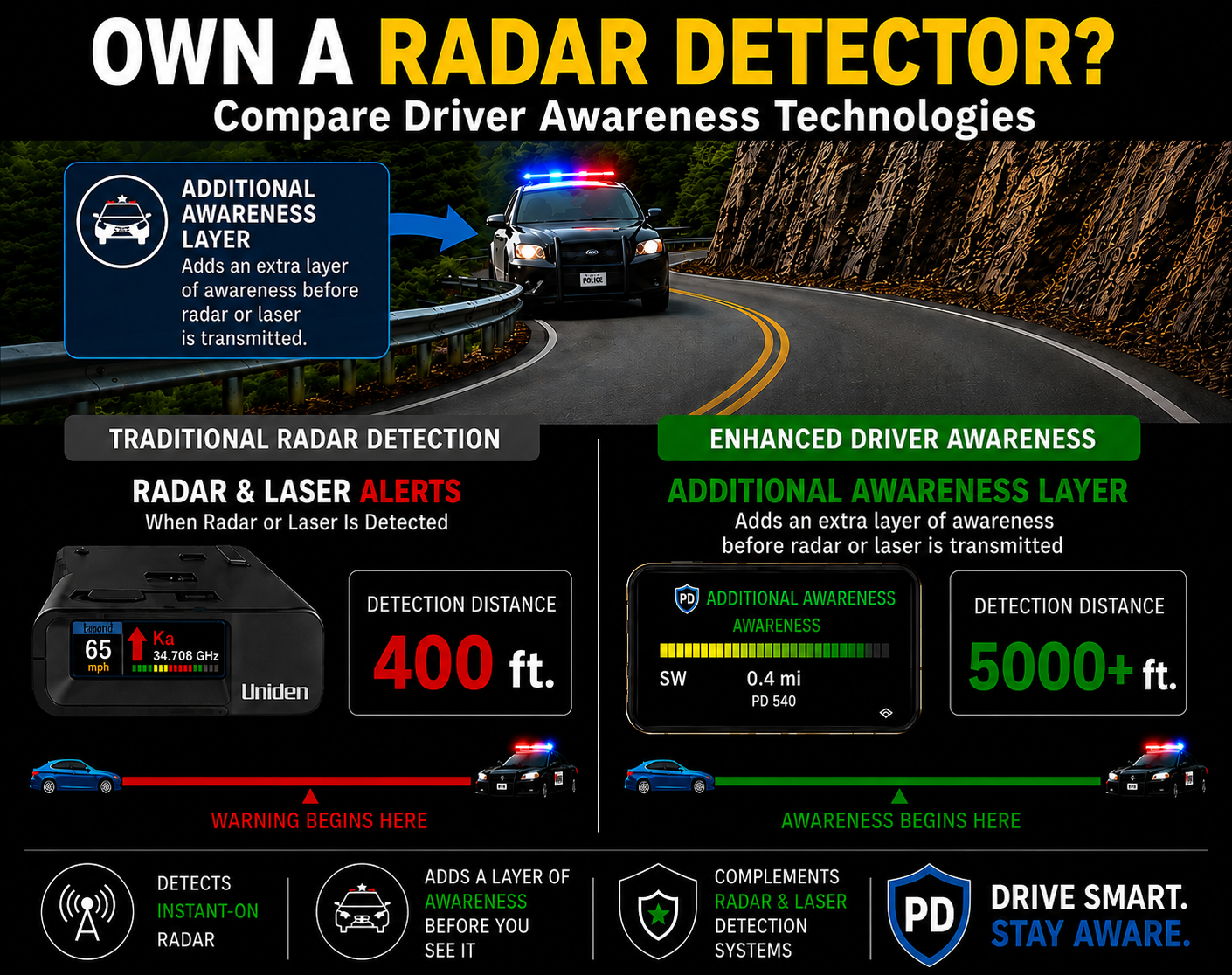
Every radar detector shares one fundamental limitation:
A police radar detector can only detect radar or laser after those signals are transmitted.
Video #2: Real Police Laser Enforcement Encounter
Laser Intercept Timeline
- 0:00 - The Police Detector begins alerting.
- 0:04 - The driver still has no obvious visual confirmation of a police vehicle.
- 0:10 - The officer still not visible.
- 0:11 - Laser fired, Uniden R4 Radar Detector immediately alerts to laser
- 0:20 - Oncoming driver flashes headlights, Laser shot occurred 9 seconds earlier
- 0:36 - Police vehicle partially concealed by trees and roadside vegetation
In this example, the Uniden R7 radar detector is doing what it was designed to do: it alerts when laser is detected. The difference is timing. The Police Detector alerted to the possible presence of the police vehicle before the laser signal was fired.
Video #3: How the Uniden R7 Radar Detector Detects Radar Around a Blind Curve
See Timestamps below
Constant-On Uniden R7 Radar Detector Intercept Timeline
- 0:00 - The Police Detector and the Uniden R7 radar detector start alerting.
- 0:18 - No obvious police vehicle in sight.
- 0:36 - The police vehicle is visible at close range.
This encounter is different from the moving instant-on radar examples shown above. In this case, the officer is transmitting constant-on radar around a blind curve.
Because a radar signal is continuously present, the Uniden R7 radar detector is able to detect the radar source before the patrol vehicle becomes visible. The Police Detector also alerts to the nearby police vehicle.
This video demonstrates a situation where both technologies perform well. The Uniden R7 and Uniden R4 radar detectors excels at detecting active radar transmissions, while the Police Detector provides awareness of nearby police vehicles. Watch the footage and compare the alerts from both systems.
The Police Detector has been tested publicly by 25 experienced drivers over 3 years in real-world driving conditions across multiple states in the Radar Detector Forum.
Many of these drivers already used top radar detectors and laser countermeasures.
Modern Radar Detector vs Police Detector
Modern Radar Detector
- Detects radar signals
- Detects laser signals
- Exceptional long-range radar detection
- Can detect constant-on radar from over a mile away, with two-mile detections possible in favorable conditions
- Can often detect instant-on radar shots aimed at vehicles ahead
- Can be limited when no radar or laser signal is being transmitted
The Police Detector
- Designed to provide awareness of nearby police vehicles
- Can provide awareness before radar or laser is activated
- Works against pacing enforcement
- Works against officers waiting with radar turned off
- Approximately one-mile detection range under typical conditions
- Does not detect radar or laser signals
A radar detector detects the enforcement signal. The Police Detector is designed to provide awareness of the possible enforcement vehicle. Modern radar detectors can detect active radar from farther away than the Police Detector can detect a police vehicle. However, the Police Detector may provide awareness in situations where no radar signal is being transmitted.
Learn More
Explore The Quick Install PD SoloRead more about modern enforcement tactics, instant-on radar, and the technology behind today's radar detectors.
Read: Do Radar Detectors Still Work? Read: Best Radar Detetector and Instant-On Radar Technology Explore The Police Detector Sensor Fusion System View Install OptionsThe Police Detector is a driver awareness system. It is not a police scanner, does not transmit, and does not intercept police communications.
Independent Feedback from Experienced Drivers
RDforum - August 14, 2022 @SuperMario007: "The system does indeed work as advertised."
- @TrackAddict: GAME CHANGER!
- @SafetyStealth: Sherlock alerts before my RD does
- @ViggenDriver: Picks up undercover cars no problem
- Ragged Edge (RDForum Owner): We need innovation like this
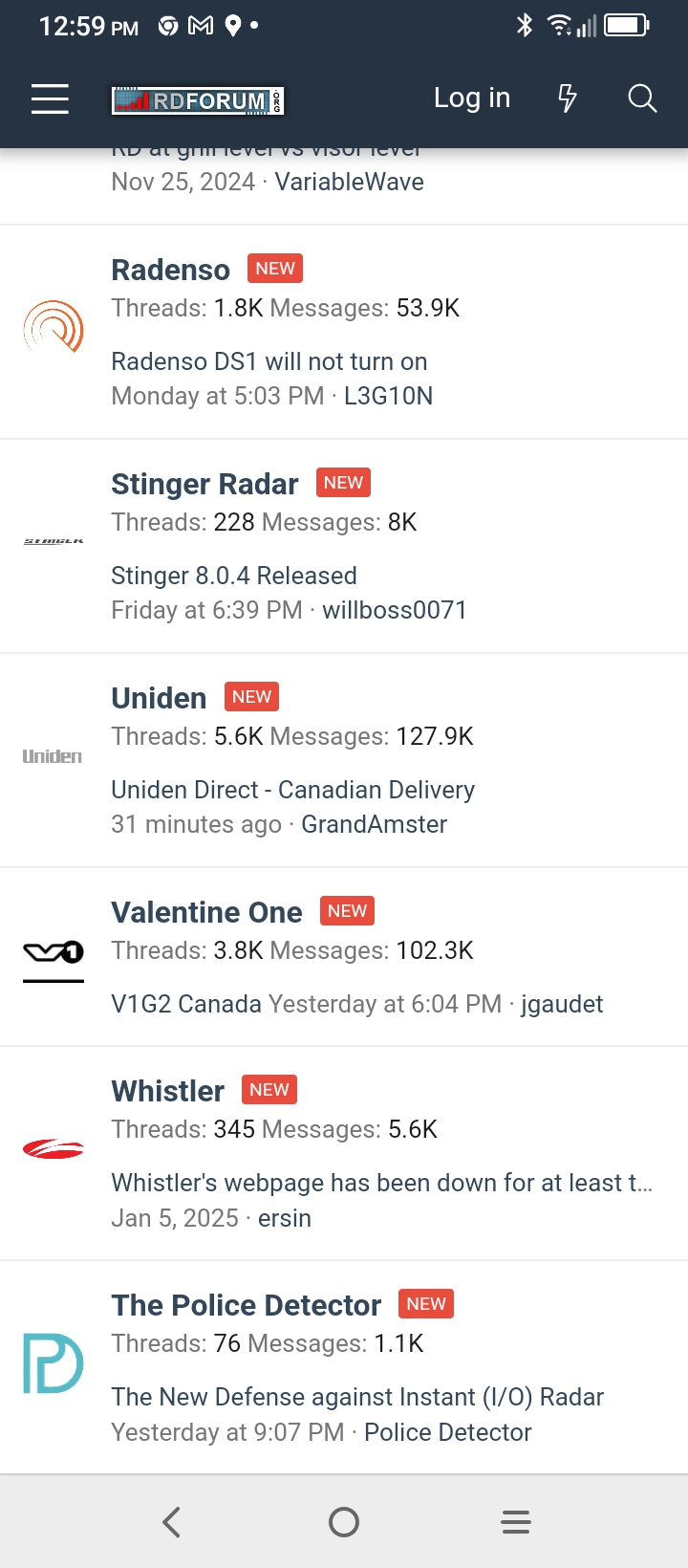
The Police Detector has been listed for four years with Valentine One, Uniden, Stinger, Radenso, and Whisler.

Conclusion
Modern police radar detectors are remarkable devices that can provide valuable warning when radar or laser signals are present.
However, every radar detector shares the same fundamental limitation: it can only respond to signals that are actually being transmitted.
The videos in this article illustrate situations where radar or laser warnings occur only after an enforcement signal has been activated.
The Police Detector takes a different approach by providing an additional source of situational awareness. Rather than monitoring for radar or laser transmissions, it is designed to alert drivers to the possible presence of nearby police vehicles.
Because the two technologies operate differently, many drivers view them as complementary tools rather than direct competitors.
Understanding the strengths and limitations of each approach can help drivers make more informed decisions about the equipment they choose to use.